

A screwdriver is not a tire iron.
Large tubeless tires have stiff sidewalls and tight beads on purpose. That stiffness is what keeps them seated and running at low pressure — and it is also what bends short tools and chews wheel edges.
- ▪ A screwdriver or a short pry bar has no spoon on the end. The edge digs into the rim, cuts the bead, and leaves a mark you cannot undo.
- ▪ The damage shows up later, as a slow leak at the bead or a rust line under the paint on a steel wheel.
- ▪ Short tools mean short levers, so the work moves from the handle to your back and hands.
- ▪ The right spoons are the cheapest part of a tire job and the part that lasts decades.

Leverage that rolls the bead instead of cutting it.
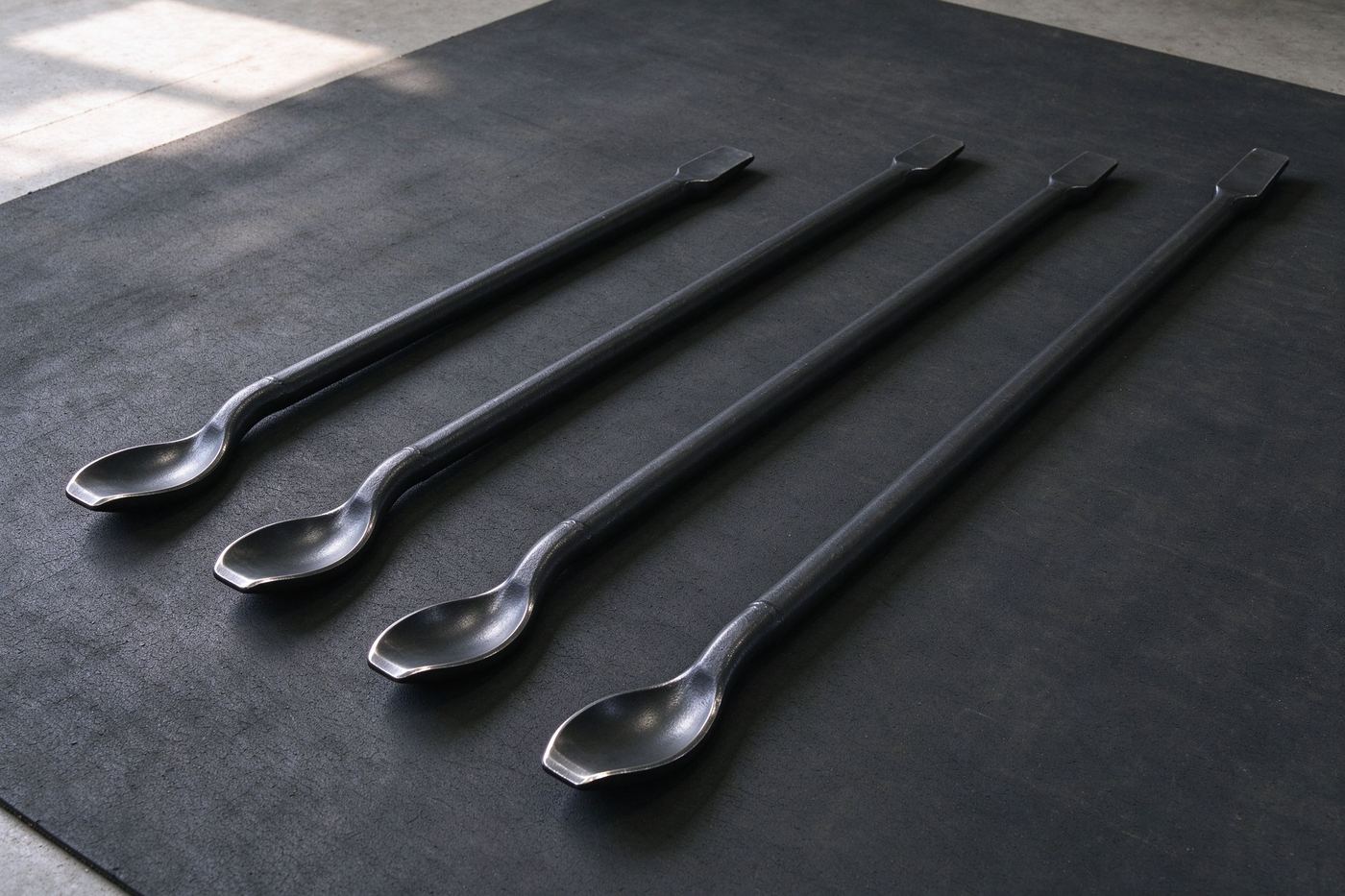
Three forged spoons, each with a curved rounded end that slides under the bead and rolls it over the rim, and a flat flared tip at the other end for starting one.

24 in to break the bead loose and start the first side, 30 in for the main lift, and 36 in for the last stiff section of a heavy implement sidewall.
The end is curved, polished and rounded smooth, so it slides under the bead and rolls it over the rim rather than shaving rubber or biting into the wheel.
Forged carbon steel takes a bend and comes back into shape. A stamped bar kinks where it was stressed and stays kinked.
Turn the tool around and the flared flat end starts a bead or lifts a stubborn edge in the gap where a spoon will not fit.
Four details that decide whether it gouges.
A tire spoon is a simple lever, so everything that matters is at the two ends and in how much bar you get between them.

- ▪ A radiused, polished working end. A sharp edge cuts the tire bead and gouges the rim. This one is rounded smooth and free of burrs, so it slides under and rolls.
- ▪ It sits flat on the rim, not on the edge of it. Held flat, the load goes into the tool. Held upright like a chisel, the same force goes into the rim face.
- ▪ Length is strength. The same pull on a 36 in bar puts about half again the load on the bead as a 24 in bar, which is why the long one is kept for the last stiff section.
- ▪ Coated shaft, bare steel where it works. The shaft is powder-coated for grip and corrosion resistance; the end that touches rubber and rim is plain polished steel.
Four steps, one rule: no air in the tire.
Order matters more than strength here. Done in this sequence, a stiff implement tire comes off with body weight rather than muscle.
Remove the valve core and let the tire deflate completely. Nothing is done on a tire that still holds pressure.
Push the bead down into the rim well with the flat end or a bead breaker, all the way around. Working the opposite side into the well is what creates the slack.
Spoon end flat on the rim, work around a few inches at a time. Save the last stiff section for the longest spoon.
Bead lubricant rather than oil or dish soap, and the spoon flat against the rim, so the bead slides into place instead of tearing.

Sized for implement tires, not for alloy wheels.
These are long tools for big, stiff tires on steel wheels. That is exactly what makes them wrong for a passenger car.
| Used on | Which spoon | Note |
|---|---|---|
| 10-16.5, 12-16.5, 31×15.5-15 and 11L-16 tires | All three | The class these are sized for: stiff sidewall, tight bead, steel wheel. |
| Skid steer, trailer, mower and implement tires | 24 in, then 30 in | Start with the short one and reach for the long one only when the bead resists. |
| Steel wheels | All three | Keep the spoon flat on the rim. Steel paint scratches, but it does not gouge the way alloy does. |
| Passenger car alloy wheels | — | Too long and too much leverage for a soft alloy rim; cars need short irons and a proper bead breaker. |
| A tire that still has air in it | — | Deflate fully before any spoon goes near the bead. |
Note: Never use a tire spoon as a punch, chisel or pry bar, and never slip a pipe over the handle for more leverage. The extra load is exactly what snaps forged steel, and it snaps without warning.
What each option does to the bead and the rim.
Four ways to get a stiff tire off a wheel, and the honest version of what each one leaves behind.
| At a glance | This 3-piece spoon set | A screwdriver or short pry bar | A manual bead breaker | A tire shop |
|---|---|---|---|---|
| Leverage | 24, 30 and 36 in bars | Whatever fits in the gap | A press, not a lever | Machine mounted |
| Effect on the rim | Rounded end held flat on the rim | Cuts and gouges the rim edge | Safe on the bead | Safe |
| Effect on the bead | Rolls it over without shaving rubber | Cuts rubber, then weeps | Pushes the bead off the seat | Safe |
| What it needs | A flat surface and your body weight | Nothing, which is the problem | A clamp or a second pair of hands | A trip and a wait |
| Best for | Getting a stiff implement tire off and back on by yourself | Creating a new slow leak | Breaking the bead before the spoons go in | Anything you would rather not do twice |
Three bars, three jobs, all in forged steel.
Lengths, weight and the tire classes these are meant for — the three things that decide whether a spoon set suits your wheel.
| Specification | Value |
|---|---|
| Pieces | 3 tire spoons |
| Lengths | Approx. 24 in (61 cm), 30 in (76 cm) and 36 in (91 cm) |
| Material | Forged carbon steel |
| Finish | Matte black powder-coated shaft; polished working end |
| Working ends | Curved rounded spoon end; flared flat pry tip at the opposite end |
| Bar | Approx. 1-1/4 in (32 mm) wide at the handle end, tapering toward the spoon |
| Weight | Approx. 2.6, 3.6 and 4.8 lb (1.2, 1.6 and 2.2 kg) |
| Rim contact | Radiused, polished edge, free of burrs |
| Tire classes | 10-16.5, 12-16.5, 31×15.5-15, 11L-16 and similar implement, trailer and skid steer tires |
| Care | Wipe off dirt and dried rubber after use; store flat or hung so the bars do not take a set |
1 × 24 in tire spoon
1 × 30 in tire spoon
1 × 36 in tire spoon
These are hand tools with long levers. For the same pull, the 36 in bar applies about half again the load on the bead as the 24 in bar, so use the shortest spoon that does the job.
Bead lubricant, a valve core tool and eye protection are not included.
Four rules that keep it safe to use.
Tire work goes wrong fast, and almost always because of what was done before the tool came out of the box.
- ▪ No work on a tire that holds air. Pull the valve core and let it deflate fully first. A tire under pressure can release its bead all at once.
- ▪ Stand beside the tire, never over it. When you re-inflate to seat a bead, keep your body out of the path and use a clip-on chuck so your hands stay clear.
- ▪ Never extend the handle with a pipe. The bar is forged for the load the handle gives it. A cheater bar puts load into the tool that it was never sized for.
- ▪ One job, one tool. Beads and rims only. Striking the end or driving it into something rounds the tip and costs the tool the one feature it needs.

Yes — that is the class they are sized for: a stiff sidewall and a tight bead on a steel wheel. Start with the 24 in bar and reach for the 36 in only for the last stubborn section.
No. They are too long and carry too much leverage for a soft alloy rim. Cars need shorter irons and a proper bead breaker.
A way to break the bead first, bead lubricant, a valve core tool and eye protection. A clip-on air chuck makes seating the bead far safer.
Keep the spoon flat against the rim rather than standing it on the edge, work a few inches at a time, and lubricate the bead before the tire goes back on.
Check that the tire is fully deflated and that the opposite side is pushed down into the rim well — that is what frees the slack. If it still will not move, it needs a bead breaker rather than more force.
- ▪ Three forged lengths, 24, 30 and 36 in, so the shortest tool that does the job is always to hand.
- ▪ Rounded, polished spoon ends that roll the bead instead of cutting it or gouging the rim.
- ▪ A flared flat pry tip at the other end for starting a bead in a tight gap.
- ▪ For 10-16.5, 12-16.5, 31×15.5-15 and 11L-16 class implement, trailer and skid steer tires on steel wheels.
3 forged spoons, 24, 30 and 36 in, with rounded ends and flat pry tips.



Reviews
There are no reviews yet.